
Spencer Cox
interview by Henri Peyre
How did you get into photography?
When I was a kid, I saved up my allowance for years, five dollars a week. I never bought anything with it. I remember at the time that I wanted to spend it on a “real” camera when I could afford it. Why? I don’t know – it just felt like something I needed to do. As soon as I had enough money saved for an entry-level DSLR, I bought one. It was the Nikon D5100 with two kit lenses. With that camera, I started taking photos around my house and neighborhood constantly. I also spent a lot of time reading articles and books about photography, to the point that it consumed my thoughts. Eventually, I got a macro lens and was able to take more interesting photos in my backyard. This was perfect for a kid who was too young to drive or go anywhere else for photography! As I grew older and had the ability to travel to different locations, I began to focus on landscape photography, and that’s what I still do today.
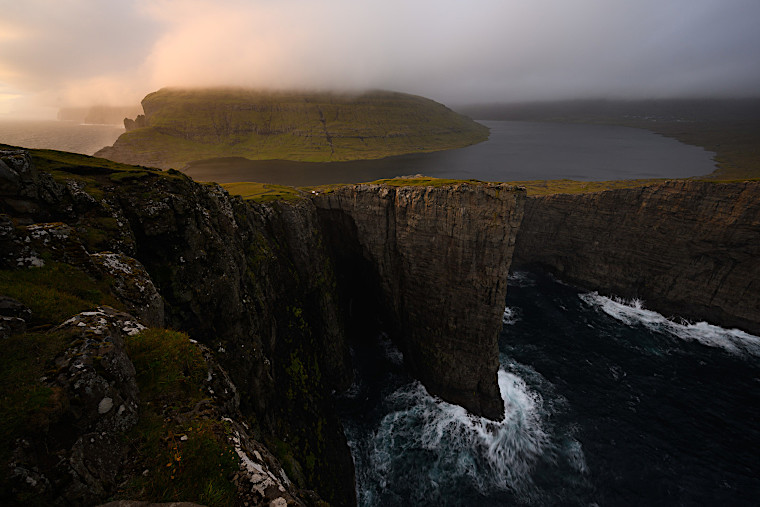
©Spencer Cox - Earth's puzzle lake Sørvágsvatn •
Faroe Islands
the author
|
Spencer Cox
|

What is, for you, a good landscape photograph?
If I knew the perfect answer to that question, maybe I
would never take a bad landscape photograph again! So, my answer is only
partial and incomplete. But I think that the best landscape photographs
are about emotion. When you are out taking landscape pictures, you feel
some emotional connection to the place in front of you. You compose the
photo in such a way to capture some of that emotional connection. You
even post-process the photo to maintain the emotion. It’s like a thread
connecting every decision you make. I think that a good landscape photo
means that everything in the photo harmonizes with that emotional thread
– nothing takes away from it or pulls it in the wrong direction. For
example, if the emotion you experience is one of terror – maybe during
an intense storm – then a jagged mountain may be a better subject than a
gentle flower. Or, if the emotion is one of peacefulness and meditation,
then low-contrast light may be preferrable to high-contrast light.
Ansel Adams said that there are always two people in every picture: the
photographer and the viewer. I agree with him. The emotions you felt,
and attempted to capture in your photo, may not be the same ones that a
viewer feels in response to the image. And you cannot totally control
how someone sees the photo. However, I think that many of my favorite
photos are the ones where I fully resonated with the artist’s vision.
That emotional thread connected me from the print all the way through
the post-processing, the compositional decisions, the light, and
ultimately back to the landscape itself.
No photo will ever be universally good or resonate with everyone who
views it. You must make photos that speak to yourself as an artist and
human being, since that’s the only thing you can control. If you are
lucky that a viewer responds to that emotional thread, cherish it.
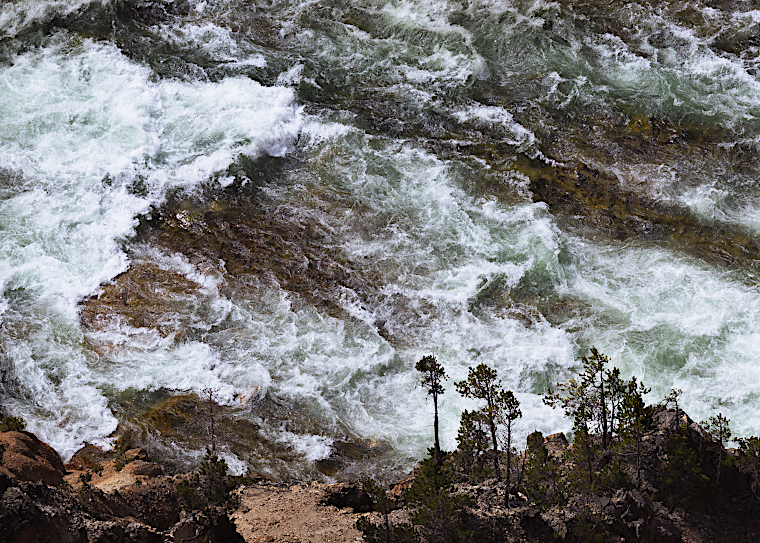
©Spencer Cox - the rapids of the Yellowstone
River, Yellowstone National Park • Wyoming
This article in french
See also :
Les
objectifs 8×10 que je recommande le plus
by Spencer Cox
on galerie-photo
You work with many cameras, and
in particular the 20x25 view camera. Why did you choose this very large
format view camera?
When I first started photography as a kid, it felt like a revelation.
And when I first started large format photography, it felt like just as
much of a revelation again. It’s how photography is meant to be for me.
My job involves reviewing cameras and lenses, and I have used almost
every interchangeable lens camera made in the last 20 years. One thing I
learned is that any one of them can be used as a tool to take good
photos. I took my favorite photo last year with one of the cheapest
mirrorless cameras that I’ve used, the Nikon Z30 with a kit lens. So, my
love of large format photography is not because it is the only way to
take good photos. At times, it is even a less efficient way to take good
photos. But mostly, it is a different way to take good photos.
Taking large format photographs is almost like painting a canvas. With
practice, it is possible to unpack, set up, and take a photo even on an
8x10” camera in just one or two minutes, just as it is possible to
“speed paint.” But I’ve never taken large format photos this way. It is
always a slow, deliberate, meticulous process for me. A lot of love goes
into each large format photo that I take – careful attention to
movements, focusing, lens choice, and of course composition. Actually, I
remember where I was, and the story behind, every large format photo
that I’ve ever taken. I don’t think anyone can say that about digital.
My choice of the 8x10” (20x25cm) format, rather than a different large
format size, is more arbitrary. It is simply the largest size where
color film is readily available today, and it is also the largest size
that I find reasonable to carry while hiking long distances. I love the
aspect ratio of this camera, too, especially for vertical photos. I’ve
always found that the 3x2 aspect ratio of most digital cameras is too
skinny for the typical vertical image.
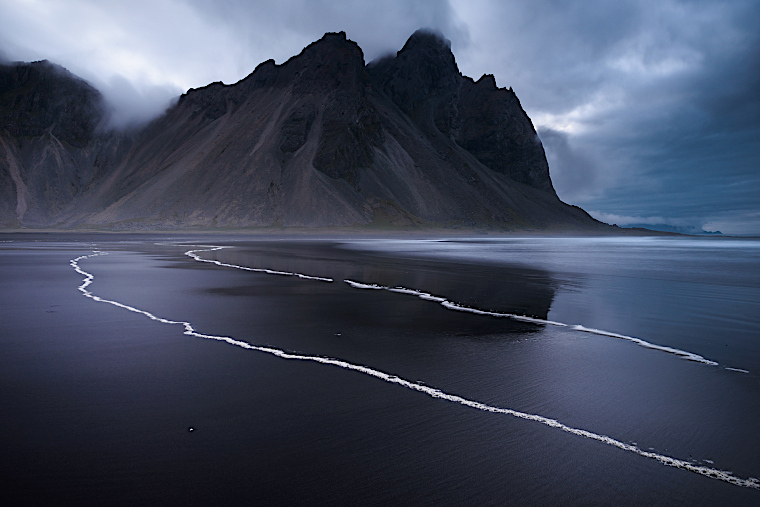
©Spencer Cox - Mass Sstokksnes Mountains •
Southeast Iceland
The notion of gigantism seems to be very important in your work. Why this choice?
To me, one of the best parts of large format
photography is the huge ground glass. Careful composition is a delight
with 8x10” cameras! I love to see every detail of the scene that I’m
capturing. With the tiny 3” LCD on a digital camera, I too often miss
little distractions in the composition that could take away from the
emotional message of the photo. And composition is my favorite part of
photography, so this is no small benefit.
Also, I don’t like to limit my future printing ability. If captured in a
certain way – with careful choice of aperture, movements, and so on –
8x10” film has enough detail to make a print at any reasonable size. So,
it allows the photographer full flexibility in the printing process.
I am not the type of photographer who believes that a bigger print is
better, though. If anything, it is usually the opposite. Smaller prints
are quieter, gentler, and more intimate. They ask the viewer to walk up
close to them. Whereas larger prints are louder, more dramatic, and
immediately impactful.
Some photos demand to be printed small, and some large. It goes back to
the idea of which emotions you are trying to convey. However, by
shooting my landscapes with 8x10” film, I don’t limit my choices. If
anything, I get the best of both worlds. It is very easy to make 8x10”
contact prints in the darkroom if the photo works better small, or make
large prints with a lot of detail if the photo works better large.
That said, in recent years, I have gravitated toward photos with a lot
of complex detail and patterns. These photos may not always demand to be
printed large, but often they do.
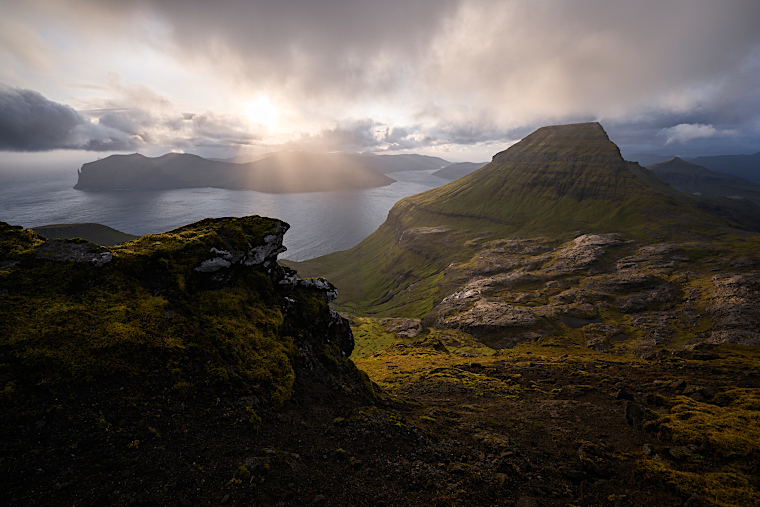
©Spencer Cox - view of Vágar - Sornfelli • Faroe
island
You are the author of a very informed article,
visible sur galerie-photo,
which deals with the choice of lenses for the 8x10. It represents an
enormous amount of work and testing that few people in the world have
been able to achieve. Are you passionate about the technique?
I do have a soft spot for lenses! Lenses aren’t just
another piece of camera equipment – they have an unusually large impact
on the creative side of photography. A photographer’s choice of focal
length is especially important. It matters in every photo. Also, a
crucial benefit of large format photography is the ability to use rise,
fall, shift, swing, and tilt creatively to achieve the desired image.
Full movements are only possible with a lens that has excess coverage
for a particular format, for example, well over 315mm of usable image
circle if shooting with 8x10 film.
Only a limited number of lenses suit these requirements – though there
are plenty for 4x5 and 5x7 photography, far fewer exist for 8x10
photography. My article began as some notes for myself about the
available lens options, and I referenced it a lot while I was buying my
kit. As my notes became more comprehensive, I decided to publish them
for anyone to read. A few times, I even bought a lens just to resell it
so that I could get the data correct in my article.
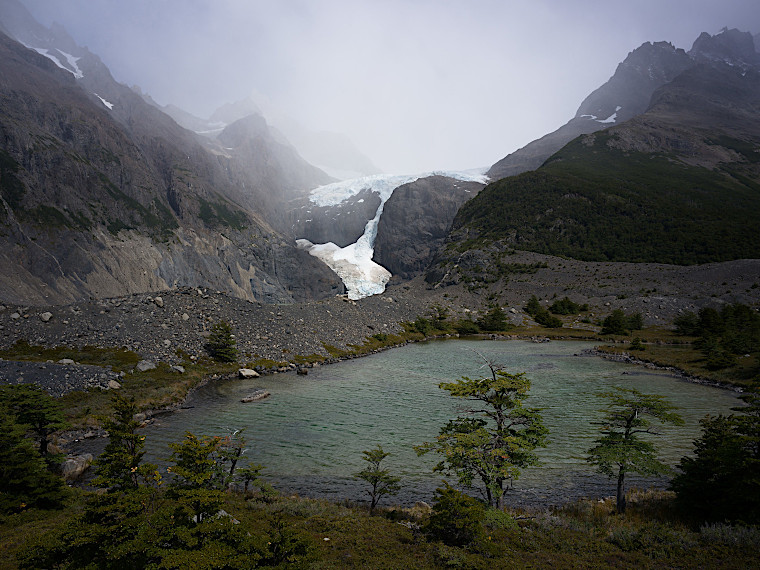
©Spencer Cox - Melting Torres del Paine • Chile
What advice would you give to someone who wants to approach the 8x10?
I believe in doing what you feel called to do in life.
Some photographers will tell you not to start with 8x10 – to start with
a smaller format like 4x5 or even medium format film – and only jump up
to 8x10 after you’ve mastered the smaller formats. I disagree. If you
feel that 8x10 photography is right for you, you can do it at any stage
in your photographic journey. However, it may be wise to start with some
cheaper B&W film and develop at home in order not to waste too much
money at the start!
8x10 photography rewards care and thought. Don’t rush through it. The
bigger the format, the slower you will need to go. There is a lot that
can go wrong if you rush, but the upside of 8x10 photography is
extraordinary if you get everything right. However, you will not achieve
it without deliberateness and attention to detail.
In the past, when people have asked me about getting into 8x10
photography, the primary thing that concerns them is the cost. That is
reasonable in today’s world. However, I would also suggest to embrace
the cost of 8x10 photography as a sign to put all your energy and
emotions into each photo that you take. I find that I could take 1000
digital photos in a week only to get five that I like. And I could take
seven 8x10 photos in a week… to still get five that I like. The cost of
8x10 is high in some ways, but it is also reasonable if you consider the
value of each photo.
In the end, every photographer needs to find their own path, and 8x10
might be that for you. Personally, it feels natural for my photography,
like putting on clothes that fit me correctly. But there are many good
film formats out there, from 35mm to ultra-large-format, and good
digital formats as well. Some will suit you and some will not. If you
try something that feels like a bad match, send it back and try again.
In other words, pick your equipment to complement your personal style as
a photographer and artist. Don’t change your art to conform with your
camera gear.
This article in french
See also :
Les
objectifs 8×10 que je recommande le plus
by Spencer Cox
on galerie-photo
dernière modification de cet article : mars 2025
|
tous les textes
sont publiés sous l'entière responsabilité de leurs auteurs |
|||||
 |
|||||
|
une réalisation phonem |
|
||||
|
|
|||||